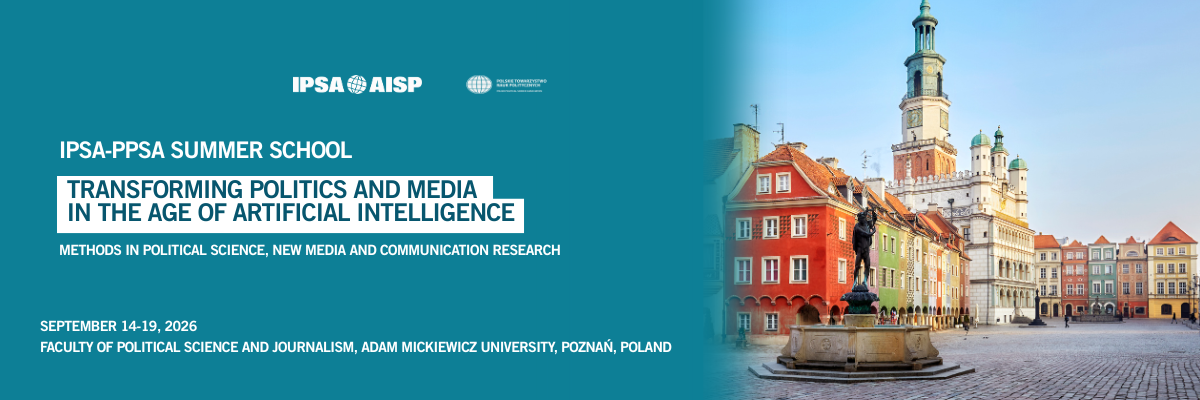
The IPSA-PPSA Summer School in Poznań will offer a series of workshops, each related to one of the cutting-edge techniques in political and communication research. The program provides participants with a review of theories and concepts frequently employed in political science and communication.
In particular, this Summer School focuses on advancing education in political science and communication methodology, with particular emphasis on the challenges of digital and AI-driven environments. The Summer School aims to create a supportive and intellectually stimulating learning environment, fostering respectful but critical dialogue between participants and leading scholars in the field.
This 5-day program is designed for PhD students and early-stage scholars (up to 5 years after receiving the PhD diploma) from around the world. It aims to improve the quality of research by strengthening their methodological competencies and analytical skills.
With an understanding of the interplay between media institutions, communication professionals, algorithms, and audiences, participants will be encouraged to critically reflect on the transformation of contemporary political communication and democratic processes.
The Summer School will offer a wide range of basic and advanced lectures and workshops in the most innovative research methods and techniques in the social sciences. Specifically, it will offer modules addressing cutting-edge challenges in contemporary political science and communication research, including:
The role of artificial intelligence in transforming media environments, political communication, and electoral campaigning;
AI-driven information disorder, trust, and misinformation in digital societies;
Algorithmic communication and the interpretation of mass political language in the digital age;
Methodological challenges and limitations in qualitative research, including interview-based studies with political actors;
Designing qualitative research projects in political science;
Q-methodology and approaches to capturing subjectivity in digital politics, including research on internet voting;
European Social Survey: Challenges of cross-national survey research and comparative data analysis;
In addition, participants of the Summer School will receive high-quality, constructive feedback on their PhD projects and research projects from lecturers, experts and practitioners.
The Summer School will also offer a chance to visit the Polish Parliament in Warsaw and the Media Research Lab at the University of Warsaw.
Our Team
prof. Magdalena Musiał-Karg – President of PPSA / IPSA Vice-President of IPSA
dr hab. Izabela Kapsa, prof. UKW – PPSA Summer School Coordinator
dr hab. Agnieszka Stępińska prof. UAM – Vice-Dean for International Cooperation, WNPID UAM
prof. Radosław Fiedler – Director of the AMU Doctoral School of Social Sciences
prof. Azul Aguiar Aguilar – IPSA Summer Schools Coordinator
For the Summer School, we plan to invite up to 20 persons. If you are interested in attending the school, please apply with the following documents:
Curriculum vitae (2 pages)
Letter of intent (1 page)
Project description (3-5 pages). The project could be either your PhD thesis, a research grant proposal, or a paper you have been working on.
Application deadline: 20 July 2026
Applicants will be informed about the outcome of the selection process by 25 July 2026.
Accepted participants will receive a confirmation email containing payment details and further organizational information. The participation fee must be paid by 20 August 2026.
participation in all Summer School sessions and workshops,
study visit to Warsaw,
local transportation in Poznań,
lunches and coffee breaks during the Summer School,
welcome/networking dinner,
Summer School materials and certificate of participation.
Fee Options
Option A – with accommodation in Poznań (single room)
Option B – with accommodation in Poznań (shared double room)
Option C – without accommodation in Poznań
440 EUR
390 EUR
250 EUR
Includes:
accommodation in a single room in a university dormitory in Poznań (13–18 September 2026),
all activities and meals included in the programme,
study visit to Warsaw (transport, accommodation, and lunch included).
Includes:
accommodation in a shared double room in a university dormitory in Poznań (13–18 September 2026),
all activities and meals included in the programme,
study visit to Warsaw (transport, accommodation, and lunch included).
Includes:
all Summer School activities and meals,
local transportation in Poznań,
study visit to Warsaw (transport, accommodation, and lunch included).
Accommodation in Poznań is not included in this option.
Participants are responsible for:
travel to and from Poznań,
personal expenses,
insurance coverage.
The number of places is limited. Accommodation will be allocated on a first-come, first-served basis.
Organizing institutions
International Political Science Association (IPSA) was founded in Paris in 1949 under the aegis of the United Nations Educational, Scientific and Cultural Organisation (UNESCO). The special mandate of IPSA, expressed in its Constitution, is to support the development of political science in all parts of the world, building academic networks linking East and West, North and South. Its aim is to create an inclusive and global political science community in which all can participate. It seeks to promote collaboration between scholars in emerging and established democracies and to support the academic freedoms needed for the social sciences to flourish.
The activities and policies of IPSA reflect its global mission. It has been highly successful in the encouragement of national and regional political science associations and today there are over 59 such associations affiliated with IPSA. IPSA has maintained its links with the United Nations and has supported the development of other international and regional political science organizations.
IPSA World Congresses of Political Science are now held every second year, moving between continents. The participation of scholars from less developed countries is supported through travel grants and the Global South Solidarity Fund. IPSA’s research committees offer opportunities for political scientists working in particular sub-fields of the discipline to associate with colleagues from around the world. Organizing events between World Congresses and playing a major role in these Congresses, the research committees encourage the world-wide pooling of skills and resources by working both together and in conjunction with specialist sub-groups of national associations.
The Polish Political Science Association(PPSA) was founded in November 1957. The organization was established to bring together all Polish scientific societies dealing with political science and the dissemination of knowledge on politics.
The establishment of the Association was a bottom-up initiative based on the need to influence decision-making. The establishment of this professional corporation was also an attempt to follow the scientific community and join political science organizations that formed the International Political Science Association (IPSA).
Adam Mickiewicz University, Poznań, Polandis the major academic institution in Poznań and one of the top Polish universities. Its reputation is founded on tradition, the outstanding achievements of the faculty and the attractive curriculum. The mission of the University is to advance knowledge through high quality research and teaching in partnership with business, professions, public services and other research and learning providers.
The Faculty of Political Science and Journalism AMUis one of the youngest and largest, in terms of the number of students, faculties at our University.It is located on the Morasko Campus in a very modern building, equipped with television and radio studios, as well as computer labs and a library, rich in material. Our staff is comprised of both academics and experienced professionals from politics, journalism, security or administration. Among the resources available to students of the Faculty of Political Science and Journalism there is a professionally equipped TV studio. Our students have access to 60 square meters of workplace – a studio and a control room. The place is used for television workshops as well as audio and topical courses. The studio is also used for the recording of two programs produced by students: “Kurier Akademicki” that is broadcast by Polish Television (TVP) and the news program of the Faculty of Political Science and Journalism – “Flesz”.We have provided our students with a spacious and comfortable radio studio comprising two rooms: the studio floor and the production control room. The studio hosts classes in radio skills, advertising, audio and video skills, enunciation skills and specialist audio classes. The programmes for the student Internet radio station, Radio Meteor, are also produced here. Students of the Faculty of Political Science and Journalism have access to two computer labs, equipped with Apple iMac computers, using OS X. Students can use them both during classes and in their free time. All computers at the Faculty have broadband Internet connection.Owing to our extensive range of software for processing graphics, audio and video, students can advance their qualifications and develop skills in all these fields.
Partners
Laboratory of Media Studies
Doctoral School of Social Science AMU
Centre for Research and European Education Centre for Research and European Education
The 24th IPSA World Congress of Political Science in Poznań
It should be emphasized that Adam Mickiewicz University andthe Faculty of Political Science and Journalism AMU were hosting the 24th IPSA World Congress of Political Science (IPSA WC2016 drew 2,587 participants, the second highest turnout in the history of this event).
From July 23 to 28, 2016, participants from 92 countries gathered in Poznań to share their research and discuss the main theme of the Congress, “Politics in a World of Inequality.” The event was a great success, with some 633 panels and 2,271 papers presented, along with a full slate of plenary and award sessions.